Showing posts with label marketing mix. Show all posts

Wednesday, 14 September 2011

The funnel is not dead … just revived in a new format, the sales and marketing timer

The funnel isn’t dead, here are 5 reasons why it is revived in a new format:


1.       The funnel should not be a funnel, but a timer. With a top [acquisition] and a bottom [retention] and a timer is in essence a closed circuit. In the top, prospects are already profiled and known [rather than an endless sea of suspects]. In the bottom, clients don’t just drop out the bottom of the funnel, but are taken care of, retained and if trust builds, could generate recommendations and positive word of mouth. You can flip a timer, not a funnel.
 
2.       The funnel was misunderstood in the first place. The sales and marketing timer is a measurement tool to track and analyze the sales and marketing situation, what is working and not working [conversion rates], is there progression through the timer, what is the speed of the progression. It helps with tracking the health of the business. It was never a description of the buyers journey, which is not necessarily linear and sometimes surprising.

3.  The funnel can't be shaken, or turned up side down, there is only one way down. A timer [sand timer, hour glass] can be slowed down by turning it upside down. The clients that become loyal can become promoters of your company and produce positive [or negative] word of mouth. Prospects buying decisions are not linear we know this, during the zero moment of truth, which can last a long while, they are changing their decision based on inputs from around them, perhaps adding more options and taking out options, or a stimulus speeds up their decision. Which is another reason why a timer is better mataphor than a funnel in defining the situation.

4.       The sales and marketing timer needs to be aligned with the buyer journey. The timer does not replace  the necessary understanding of where the buyer is in their journey. In order to use the timer effectively, it is necessary to question, listen, observe and analyze the behavior and triggers that indicate where the buyer is in their journey and then track this in the timer. As a result, sales and marketing can identify what is needed to pull the buyer/client to the next stage of the timer, if they know where they are currently.

5.       Both inbound and outbound can impact the speed of movement through the timer. New inbound conversation channels such as social media don’t make the timer obsolete. Sales people will tell you, their outbound communication channels such as [cold] calling are still a very sound way to generate quality leads. Social media can help pull prospects to the next stage of their buying journey, through educating and helping, as opposed to hard selling. The timer tracks how quickly they are pulled to the next stage and which activities and triggers have been most successful in achieving this progression.

6.       Sales and marketing colleagues need a collaboration tool more than ever. Sales and marketing have never made great bedfellows, so taking away a great collaborative tracking tool such as the timer is going to widen the divide.  Marketing needs to become more accountable to the business and closing the loop and tracking ROI is essential for its survival. Sales needs the timer to track their pipeline and forecasts and use this to communicate with marketing about how to gain movement in the timer and where marketing and sales should focus their [individual and joint] efforts.  


Sources:

Saturday, 13 February 2010

Convenience is the new price

Time is scarce, consumers both business and private all have busy lifestyles and their time needs to be wisely spent. Price is no longer as influencial in the decision making process as it used to be, when Kotler started talking about the 2nd P for price.

Convenience is the new P for price, if the brand creation is not convenient it will not sell now adays, even if it is the cheapest. This is not to say price is completely irrelevant, it is just less important in relation to the other elements of the customer decision making tree.

When I talk about convenience, this is convenience of product, the channel, the service and experience, not just online channel convenience, but across all interactions the customer has with the brand experience. Convenience does not translate into more features or faster, the key criteria for convenience, is if it saves the customer time, because it is so convenient to buy, deliver, consume or use.

Of course companies have known this for a long time, there are enough brand failures that show that launching the product with the most features is not the way to win over consumers [Betamax is a prime example of this] especially if it is too complicated. And companies didn't move to sell online just because they thought consumers prefer sitting behind their computers, but because they knew it was more convenient for some consumers to buy that way. So this is nothing new. What is new is making convenience more of a focus in the marketing mix than price is/was against the other elements.

Convenient brand experiences are easier to create if brands have done this hand-in-hand with their customers. Convenience happens to coincide nicely with being able to measure more conversion across all combination of channels, which is the topic of my next blog entry.

Convenience is the 5th of the 6 c's of measurable marketing: customer, content, conversation, creation, convenience and conversion.

Friday, 12 February 2010

Creations are not just simple products but brand experiences


Creation is not about just about products [as Kotler may have you believe], but it is about the overall customer experience of your brand.

The creation of the right experience happens with the help of many stakeholders both inside and outside the company.

Co-creation is nothing new, because companies have been doing this in different formats for a long time. But with the help of social media companies can now do this more effectively and efficiently by using their virtual networks, fan communities and conversations with their customers to co-create the right mix of products/services and experiences to create the brand experience.


If customers are involved more with your brand creation than they were previously through being able to impact the evolution of the brand, you can further solidify this already strong relationship. By selecting those customers and target groups who are involved in active conversations with your company, whether those be positive or negative, it is importance to use these passionate people to positively impact the creation and evolution of your brand.

Make these passionate people and influencers part of the creation of your brand experience, they will then be your best advocates for the brand.

Creation is the 4th in the 6 c's of measurable marketing: customer, content, conversation, creation, convenience and conversion.

Thursday, 11 February 2010

From push, to pull marketing and even better conversations


Marketing over the course of the last few years has moved from push marketing to pull marketing techniques.
The next step in this evolution is from pull marketing to dialogue / conversations with the target audience.
The main challenge with conversations, is its scalability which hasn't been addressed enough even among the millions of social media experts out there.
You may say that B2B firms have been having conversations for years with their sales force conversing with customers, but that is only if they are focused on solutions vs transactional sales, which in most cases is simply not true.
In order to start conversations, highly valuable content is necessary and once you have conversations with your target audience, you can spot your promotors and detractors and integrate them into your inner core to help you create the right brand experiences.
Conversation is the 3rd of the 6 c's of measurable marketing: Customer, content, conversation, creation, convenience and conversion.


Wednesday, 10 February 2010

Content helps build a conversation


I would argue that content comes before conversation, without content there will be no conversation with your target audience.

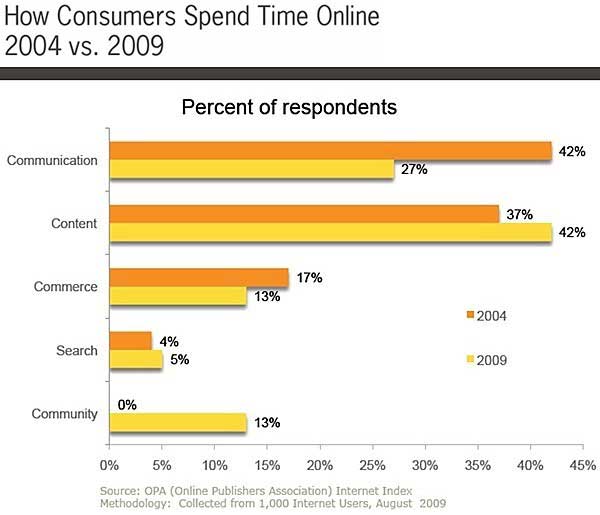
The importance of content has always been paramount, remember people talking about content is king, a little cliche now right? Well it still is king, but it needs to be used to create a conversation with your audience, not as a one way dialogue. Leading brands have always seen the benefit of creating content [P&G], but more and more brands are becoming media companies and using media to become thought leaders and influencers.

The diagram to the left from MarketingProfs shows the importance of content to online consumers and how the time spent with content, communication, commerce, search and community has changed between 2004 and 2009.

Content however is constantly being devalued so it needs to stand out from the crowd, some writers [including the authors of Made to Stick] measure the likely success of ideas using this acronym SUCCESS: simple, unexpected, concrete, credentialed, emotional and story [s]. I believe this is also relevant for content, if you get this formula right people are likely to value your content and engage with you in a conversation around this content and over time see your brand as a thought leader.

Equally your content needs to either answer a question, resolve a problem, help them make a decision, provide them with new insight or simply entertain them.

It has become easier to measure the impact of your content, compared with the situation without content, simply by taking a baseline measure and tracking over time the impact relevant valuable content has had on your KPI's. Especially now with social media tools, it is possible to track content and conversations around that content and repeat traffic generated by content. More on measurement and conversion shortly.

Content is the 2nd of the 6 c's of measurable marketing: customer, content, conversation, creation, convenience and conversion.

Monday, 8 February 2010

Customer centricity is the only way, or the highway

My way [ie. the customers] or the highway! If you don't start with the customer / potential customer in mind what ever you measure is going to mean nothing, as you will have started from the wrong place.

When I say customer, I also mean target group of customers/consumers, this depends on whether we are talking B2C or B2B.

Whether you are creating a new product, or website, thinking about changes in price, redefining your media mix, or deciding whether to use new channels to market, it should all start with a very good understanding of the customer/target audience.

It is necessary to use both qualitative and quantitative methods to analyze the current situation with your customers, create scenarios from trends and come up with insights that help you drive your strategy and decision making. The subject of research methods is too long a subject to discuss here and there are many other blogs that do a great job of that.

There are so many diagrams and graphs searchable in Google when you search "customer centricity", like the diagram from Wisper, it explains how companies need to focus on the customer and how you internally lead the customer through the purchase funnel, but it flawed because it is from the company's perspective not from the customer's perspective. In fact non of the diagrams I found about customer centricity discussed it from the customer's point of view.

A consumer whether purchasing something for themselves or for their company, will go different stages in the purchase decision, I have mapped this out with the use of a rough mind map. This is by no means complete and may look different for different types of people/purchases/industries, but the important thing to bare in mind, is that people are not going to make decisions the way companies want them to, so get to know your customers, how they make decisions, who they turn to, how they turn to others, their time lines, when they need help with making their decision and at what stages they need help and ultimately when you can influence their decision.

In this diagram below, you will see multiple mentions of peer recommendations and zero mention of advertising, this is not to say that advertising does not play a subconscious role in their decision making, but they probably won't realize it is part of their decision, unless in fact their only decision is based on if it is from a particular brand, in which case they are a real fan of the brand [which is the aim of any brand of course]. More and more customers are turning to peers for advice during purchase in fact in recent surveys up to 78% trust peers compared with 14% who trust advertising. If brands use social media to build trust and not as an advertising channel, social media tools could also be considered peer recommendations.


The highway is a lonely place to be, so make sure you are being customer centric and go the customer's way. Customer is the 1st of the 6 c's of measurable marketing: customer, content, conversation, creation, convenience and conversion.

Thursday, 21 January 2010

The difference between B2C and B2B marketing

This is the 2nd in a series of doodles I am going to publish. I invite you to doodle over the top of them in a red pen and send them to me, so I can republish them all on this blog. In the doodle I have outlined with help of the 6 C's the differences, over the course of the next weeks I will go into detail on each of these.

Business-to-business (B2B) and business-to-consumer (B2C) marketing is different. Some people think marketing is marketing and whether you are marketing to consumers or marketing to businesses, you are still just marketing to people, right?

Well, yeah they are people, but a person buying a product for themselves verses buying for their company is a very different, emotional experience. In fact, there are profound differences that you must remember when developing your marketing activities.

Although the marketing programs are similar, the mix used will differ for each type of business (events, direct marketing, internet marketing, advertising, public relations, word of mouth, social media and alliances etc), how they are executed, what they say, and the outcome of the marketing activities differ.

However the MAIN difference, is in B2B the buyers (often decision making teams) of the business budget, need to often justify in quantifiable terms the value from their purchase during budget review. This means B2B sellers need to prove the measurable value (quantify) to the buyer before and after purchase.

Thursday, 24 December 2009

From the 4 P's of marketing to the 6 C's of measurable marketing

I am a real doodler, my colleagues and clients have remarked on it! I like to scribble and draw diagrams and visually show links between concepts. I have had to manage or teach/coach some young talent and they seem to respond well to doodling as opposed to written memos or emails.

So here the first in a series of doodles I am going to publish. I invite you to doodle over the top of them in a red pen and send them to me, so I can republish them all on this blog.

I have all the respect in the world for Philip Kotler the marketing master, however I feel that the 4 P's has passed it's sell by date. I believe for marketers to be successful, they need to be practicing the 6 C's of marketing: Customer, content, conversation, creation, convenience, conversion.